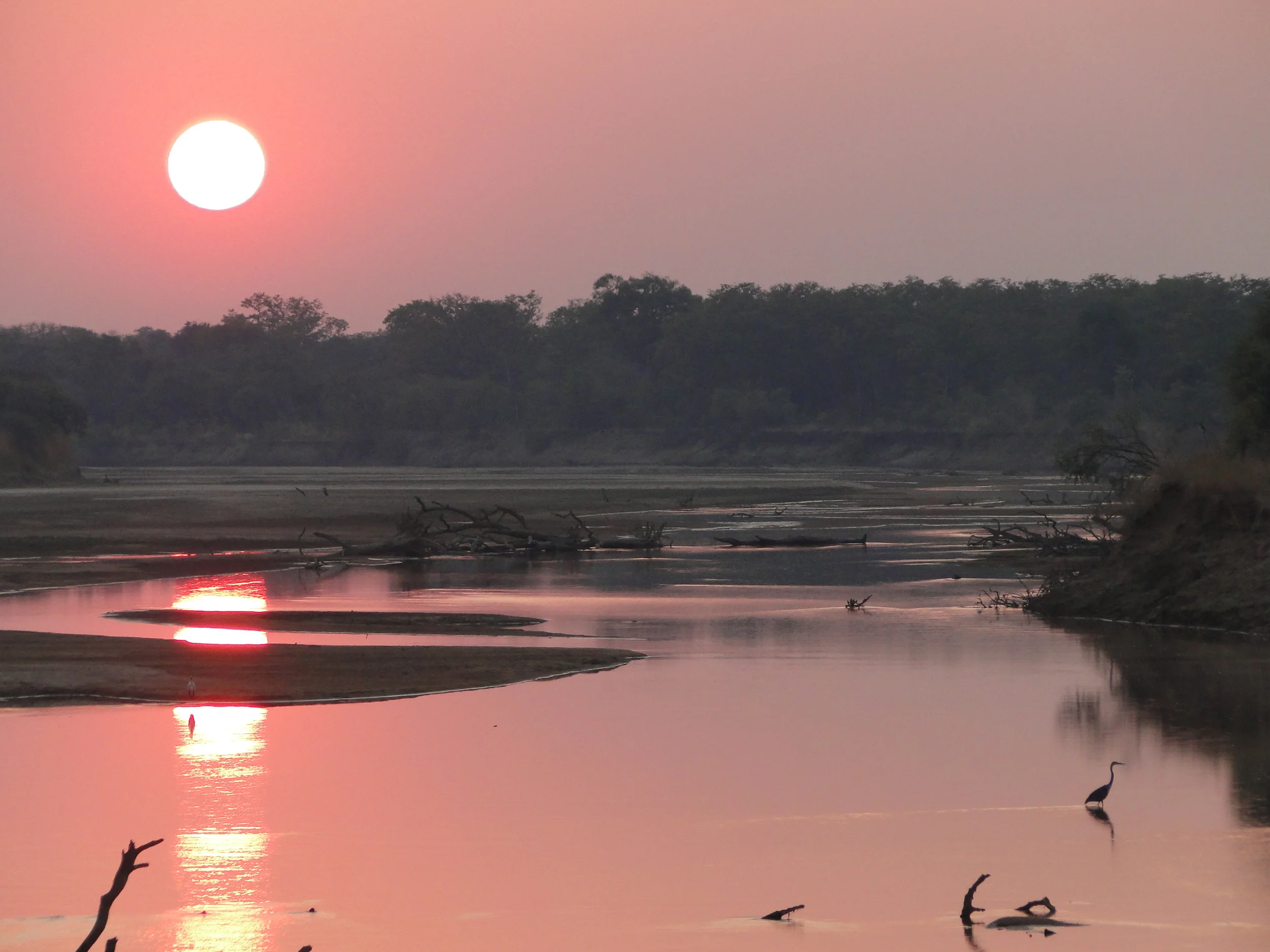
Luangwa Valley
The Luangwa Valley is home to three national parks, each forming part of one of Africa’s most important and intact wildlife ecosystems. The largest and best known is South Luangwa National Park, the oldest protected area in the valley. Originally declared a hunting reserve in 1938 and upgraded to a national park in 1972, South Luangwa covers 9,050 km² and includes 247 kilometres of the Luangwa River — the lifeline that sustains an extraordinary abundance of wildlife.
South Luangwa is divided into two sectors: the widely visited Mfuwe sector, and the more remote, exclusive Nsefu sector, where wilderness, silence and wildlife density reach their peak.
Further north lies Luambe National Park, the smallest of the three, covering just 247 km². It was officially opened in 1999 and remains one of the least disturbed areas in the entire valley.
At the northernmost end of the system stands North Luangwa National Park — the wildest, most remote and most pristine of the three. This park is considered one of Africa’s great natural treasures, a vast landscape largely untouched by tourism. It was selected by the Zambian government and the Frankfurt Zoological Society as the site for the reintroduction of the black rhino, due to its exceptional ecological integrity.

Elephant crossing point from Safari Explorers Camp
Nsefu sector
South Luangwa National Park is divided into two sectors: Mfuwe and Nsefu. Mfuwe is the more commercial area, home to most of the lodges and camps, as well as the overland truck campgrounds. Access to the Park is through the iconic Mfuwe Bridge, and during peak season this sector receives a high volume of visitors.
The Nsefu Sector lies to the north, following the course of the Luangwa River. It is far more exclusive, and within the entire national park only two operators are based inside this sector — one of them is Safari Explorers Camp.
Nsefu holds exceptional wildlife richness, thanks to a unique characteristic: both banks of the Luangwa River are part of the National Park. This is the only place in the entire Luangwa Valley where this occurs, and it creates ideal conditions for wildlife to flourish undisturbed.
Within Nsefu we find remarkable areas such as the Hot Springs, the Salt Pan Plains, the Stork Colony, and the incredibly rich riverine habitats along the Luangwa River. The populations of lions, leopards and wild dogs are particularly high here. Visitors may also encounter enormous herds of buffalo, impala and puku, elephants crossing the river, and the uniquely beautiful Thornicroft’s Giraffe.

Thornicroft giraffes 200 metres from Safari Explorers Camp
SAFARI EXPLORERS CAMP
Our camp is located in the northern part of the Nsefu Sector, inside South Luangwa National Park and close to the Chikwinda Gate. Positioned directly along the Luangwa River and near the famous Stork Colony, our location offers guests one of the most privileged settings in the entire valley.
Being inside the National Park is a decisive advantage: guests do not need to wait at the entrance gate when it opens at 06:00, complete paperwork, or drive through long stretches of general-use roads with little wildlife. We begin our safaris immediately, surrounded by nature from the very first minute.
This area is exceptionally rich in wildlife, and it is common to see animals moving around the camp itself — often visible from the veranda of our bungalows. Each night, we fall asleep to the sound of lions roaring in the distance, a timeless and increasingly rare soundtrack of our beloved Africa.

Safari Explorers Camp Bar